
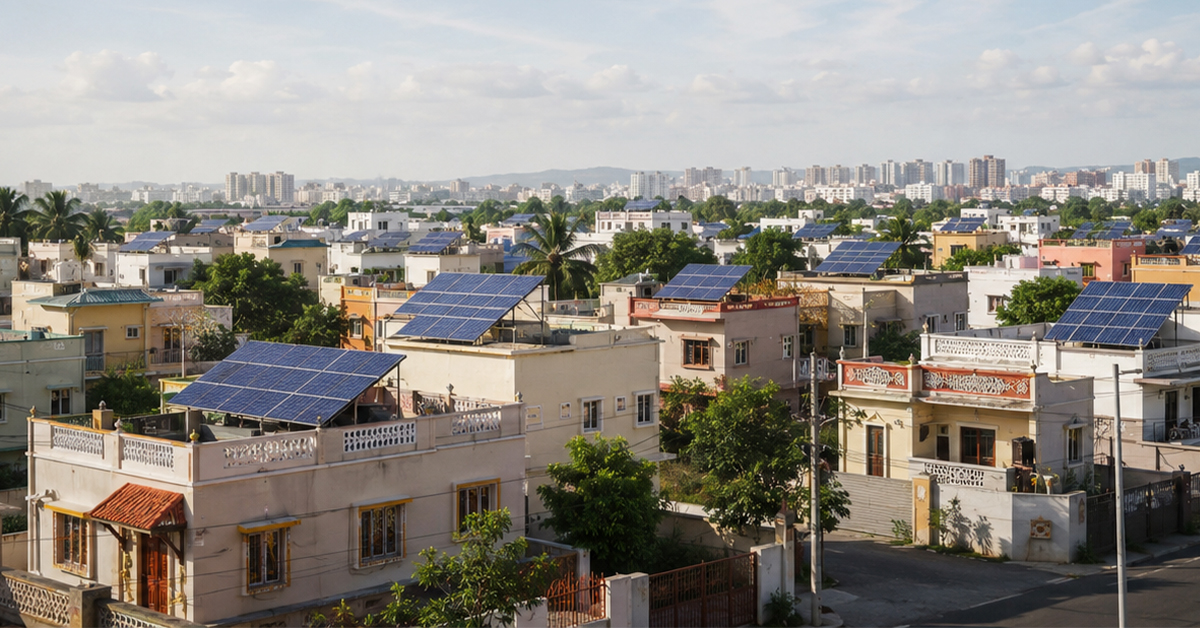
Telangana Accelerating Renewable Energy Push
As the world increasingly shifts toward alternative energy sources to reduce emissions from conventional power, the Government of Telangana is accelerating its push toward renewable energy. In a significant move, the state is considering an ambitious plan to develop one solar-powered village in every Mandal, with the proposal currently under review for pilot implementation.
Groundwork Underway
The state has already initiated solar power installations in 81 villages, covering both domestic and agricultural sectors. These systems are expected to benefit over 38,000 households and more than 16,000 agricultural pump sets, highlighting a dual focus on rural electrification and enhanced farm productivity.
The proposed Mandal-level solar village model builds on this progress, aiming to establish decentralized energy hubs that reduce dependence on conventional power. The initiative aligns with Telangana’s broader vision of expanding green energy capacity while improving access in rural and semi-urban regions. If implemented, it could position the state as a leader in village-level solarization and offer a replicable model for other regions.
Massive Rooftop Solar Push
In a major step toward harnessing green energy, the state government is also working on installing rooftop solar panels for all economically weaker households. In the first phase, the target is to cover 20 lakh homes by December, with an estimated investment of ₹24,000 crore. The government aims to extend coverage to all eligible households within two years.
Telangana has already accelerated rooftop solar adoption under the PM Surya Ghar Muft Bijli Yojana, with over 40,000 households equipped with 2 kW systems. Additionally, under the PM-KUSUM Scheme (Component-C), solar plants have been installed for more than 16,700 agricultural pump sets.
To support this expansion, the state has sought ₹12,000 crore in subsidies from the Ministry of New and Renewable Energy, which has reportedly responded positively.
Financial Benefits for Households and Farmers
Under the rooftop solar initiative, households can save up to ₹14,000 annually on electricity bills and earn an additional ₹5,000 by selling surplus power to the grid. Farmers, too, stand to benefit from fully funded solar pump sets, with opportunities to generate extra income during non-cropping seasons.
Solar infrastructure such as sheds can also provide added utility, including shade, cattle shelter, and storage space. The government is further planning to install solar systems across schools and public offices to reduce pollution and improve environmental health.
Policy Adjustments and Implementation Model
Under the current scheme guidelines, subsidies of ₹30,000 per kW (up to ₹78,000) are transferred directly to beneficiaries. However, the state has proposed routing subsidies directly to solar companies to streamline execution, especially for large-scale deployment among economically weaker sections.
Pilot installations are already underway in 40,000 households through private developers. With the Centre’s approval for subsidy routing to companies, the state has requested similar support for the larger 20 lakh household rollout.
The estimated cost for installing 2 kW systems across 20 lakh homes is about ₹1.2 lakh per household. Of this, ₹60,000 will be covered through subsidies, while the remaining ₹12,000 crore is proposed to be financed through loans.
Impact on Power Distribution
The initiative is expected to generate around 1.6 crore units of electricity daily, with surplus power fed into the grid. Currently, DISCOMs procure electricity at an average cost of ₹5 per unit. This initiative could result in power worth ₹8 crore being supplied daily at no additional cost, translating to monthly savings of approximately ₹240 crore for power distribution companies.
About Indosol Solar
Indosol Solar Pvt. Ltd. is the solar PV Manufacturing arm of Shirdi Sai Electricals Limited (SSEL). It is spearheading India’s Renewable Energy mission by developing fully vertically integrated giga-scale solar PV manufacturing ecosystem, spanning the entire value chain from quartz to high efficiency solar photovoltaics modules. It has commenced operations with a 500MW module manufacturing facility at Ramayapatnam in Andhra Pradesh. It is rapidly scaling up and aims to achieve 10GW of integrated solar PV manufacturing capacity by 2027.