
Building India's Solar Value Chain: The Key to Becoming a Global Export Hub
India’s solar manufacturing industry stands at a defining moment. Over the last few years, the country has been rapidly expanding its solar module manufacturing capacity, driven by strong domestic demand, government incentives, and the global push to diversify supply chains away from China.
However, manufacturing solar modules alone will not make India a global leader. The real opportunity lies in building a fully integrated solar value chain right from polysilicon to modules, capable of competing with the world’s largest manufacturers. Such an ecosystem will not only reduce India’s dependence on imports but also position the country as a preferred supplier to the United States and other global markets.
The Current State of India’s Solar Manufacturing
India has made remarkable progress in module manufacturing. Several domestic companies have established large-scale production facilities for solar modules and solar cells, supported by initiatives including Production Linked Incentive (PLI) Scheme, Approved List of Models and Manufacturers (ALMM), Basic Customs Duty (BCD), and Domestic content requirements for government projects.
Today, India has become one of the fastest-growing solar manufacturing destinations outside China.
Challenges Faced by Indian Solar manufacturers
Most Indian manufacturers continue to rely heavily on imported upstream materials including Polysilicon, Silicon ingots, Silicon wafers, silver paste, Solar glass, EVA encapsulants Backsheets, and Junction boxes. This dependence limits India’s competitiveness in international markets.
India’s Dependence on Imports
Although India assembles high-quality solar modules domestically, much of the raw material still originates from China. China currently dominates almost every stage of the solar manufacturing ecosystem:
- Over 90% of global wafer production
- Around 90% of polysilicon processing
- More than 80% of solar cell production
- Significant control over solar glass and auxiliary materials
Apart from China, India imports certain components from countries including Vietnam, Malaysia, Thailand, South Korea, Taiwan, and Indonesia.
However, China remains the primary supplier because of massive manufacturing scale, lower production costs, integrated supply chains, advanced manufacturing technologies, and strong logistics infrastructure.
This dependence creates supply chain vulnerabilities whenever geopolitical tensions, trade restrictions, or logistics disruptions occur.
Why Value Chain Manufacturing Matters
A solar module is only the final product of a long manufacturing process.
The complete value chain includes:
Quartz → Polysilicon → Ingot → Wafer → Solar Cell → Solar Module → Power Plant
If any stage depends on imports, manufacturers face:
- Higher production costs
- Foreign exchange exposure
- Supply uncertainties
- Longer lead times
- Reduced export competitiveness
If India succeeds in building a fully integrated solar value chain, it can reduce import dependence, strengthen energy security, create high-value employment, and emerge as one of the world’s leading exporters of high-quality solar products.
As international markets, particularly the United States, seek diversified and dependable sources of solar products, India has a historic opportunity to evolve from a fast-growing domestic market into a global clean energy manufacturing hub. By investing in upstream capabilities, innovation, quality, sustainability, and export-oriented infrastructure, India can secure a lasting role in the global energy transition while strengthening its economic and industrial leadership.
The United States is expected to remain one of the world’s largest solar markets over the coming decade. As global supply chains diversify, India has a unique opportunity to establish itself as a trusted manufacturing partner.
India’s Opportunity in the US Solar Market
India offers several strategic advantages:
- Large Manufacturing Base
- Indian manufacturers have announced tens of gigawatts of integrated manufacturing capacity across modules, cells, wafers, and ingots.
- Skilled Workforce
- India possesses one of the world’s largest engineering and technical talent pools.
- Competitive Manufacturing Costs
- Labor costs remain competitive compared with many developed economies.
- Stable Democratic Environment
- International buyers value India’s transparent legal framework and political stability.
- Growing Renewable Energy Ecosystem
- India’s rapidly expanding domestic solar market enables manufacturers to achieve economies of scale while serving export markets.
Why the United States Needs Alternative Suppliers?
The United States is aggressively expanding solar deployment to achieve its clean energy and manufacturing goals.
At the same time, US policymakers are seeking to reduce dependence on Chinese solar products through:
- Anti-dumping duties
- Countervailing duties
- Tariffs on Chinese-origin products
- Supply chain diversification initiatives
- Domestic manufacturing incentives
As a result, US developers are actively looking for reliable manufacturing partners outside China. India is emerging as one of the strongest alternatives.
What India Must Do to Become a Leading Exporter to the USA
Although the opportunity is enormous, becoming a preferred supplier requires much more than module manufacturing.
- Build Complete Vertical Integration
India must invest in:
- Polysilicon plants
- Ingot manufacturing
- Wafer manufacturing
- High-efficiency cell technologies
- Module assembly
A fully integrated ecosystem reduces import dependence and enhances global competitiveness.
- Increase Domestic Raw Material Production
India should strengthen domestic production of:
- Solar glass
- EVA films
- Backsheets
- Junction boxes
- Frames
- Connectors
- Silver paste alternatives
Local sourcing improves supply resilience and lowers production costs.
- Focus on High-Efficiency Technologies
The global market is rapidly shifting toward advanced technologies such as:
- TOPCon
- Heterojunction (HJT)
- Back Contact (BC)
- Tandem Perovskite-Silicon cells
Continuous investment in research and development will help Indian manufacturers remain competitive.
- Improve Manufacturing Scale
Global buyers prefer suppliers capable of delivering large volumes consistently.
Indian manufacturers should establish giga-scale facilities that match international production standards while maintaining quality and efficiency.
- Achieve International Certifications
US customers require compliance with rigorous technical and sustainability standards.
Manufacturers should obtain globally recognized certifications and demonstrate robust quality assurance systems to build confidence with international buyers.
- Strengthen Supply Chain Traceability
Global customers increasingly demand transparent sourcing and environmental accountability.
India can differentiate itself by implementing digital traceability systems covering every stage of production, from raw materials to finished modules.
- Invest in Logistics and Export Infrastructure
Efficient exports depend on:
- Modern ports
- Faster customs clearance
- Reliable container availability
- Efficient inland transportation
- Lower logistics costs
Reducing logistics bottlenecks will improve India’s competitiveness.
- Expand Trade Partnerships
India should continue strengthening trade and commercial relationships with key export destinations, including the United States, through market access initiatives, investment promotion, and supply chain cooperation.
- Develop Green Manufacturing
As sustainability becomes a purchasing criterion, manufacturers powered by renewable energy, low-carbon processes, and environmentally responsible operations will gain a competitive advantage.
- Green manufacturing can become a distinctive strength for India’s solar industry.
The Role of Integrated Manufacturing
Integrated manufacturing delivers multiple strategic benefits:
- Lower production costs
- Greater supply chain control
- Reduced import dependence
- Faster innovation
- Improved product quality
- Better pricing power
- Enhanced export competitiveness
Companies investing across the entire value chain right from polysilicon to modules, will be better positioned to serve global markets and capture higher margins.
India’s ambition should extend beyond becoming a major solar market; it should aim to become a global manufacturing powerhouse.
Realizing this vision will require sustained investments in upstream manufacturing, advanced technologies, research and development, logistics, skilled talent, and supportive policy frameworks.
The future of India’s solar industry lies not merely in assembling modules but in mastering the entire manufacturing ecosystem. A robust, vertically integrated value chain right from polysilicon to finished modules will enhance resilience, improve cost competitiveness, and position India as a reliable global supplier.
Indosol Solar’s Role in Making India an Export Hub
Indosol Solar is playing a pivotal role in strengthening India’s position as a global solar manufacturing and export hub. With one of the country’s largest fully integrated solar PV manufacturing facilities at Ramayapatnam, Andhra Pradesh, the company is contributing to India’s vision of becoming a self-reliant and globally competitive clean energy manufacturing nation.
The company is developing an integrated, giga-scale solar manufacturing ecosystem spanning the entire solar value chain right from quartz processing and polysilicon to ingots, wafers, solar cells, and high-efficiency photovoltaic (PV) modules. As a beneficiary of the Approved List of Models and Manufacturers (ALMM), Indosol Solar supports the Government of India’s initiatives to promote domestic manufacturing and reduce dependence on imports.
Indosol Solar commenced operations with a 500 MW solar module manufacturing facility and has since expanded its capacity to 1 GW. As part of its long-term growth strategy, the company is progressing toward its vision of establishing 20 GW of fully integrated solar PV manufacturing capacity, reinforcing India’s energy security while creating a globally competitive manufacturing base.
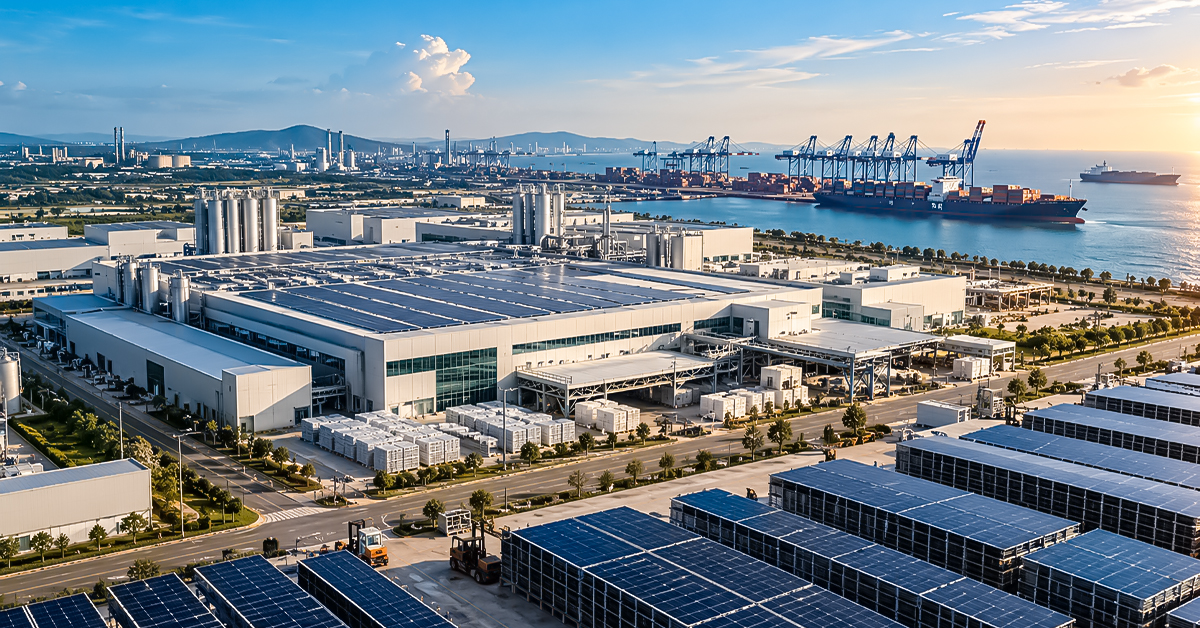
Strategically located adjacent to the upcoming Ramayapatnam Port on India’s east coast, the facility offers significant logistical advantages for exporting solar products to international markets, including the United States, Europe, the Middle East, and Africa. This proximity to a deep-sea port enables efficient and cost-effective global distribution, enhancing India’s competitiveness in the global solar supply chain.
Manufactured to internationally recognized quality and performance standards, Indosol Solar’s PV modules deliver superior efficiency, reliability, and long-term durability. By combining advanced technology, integrated manufacturing, and strategic infrastructure, Indosol Solar is well-positioned to support the global clean energy transition while establishing India as a trusted supplier of high-quality solar products worldwide.