
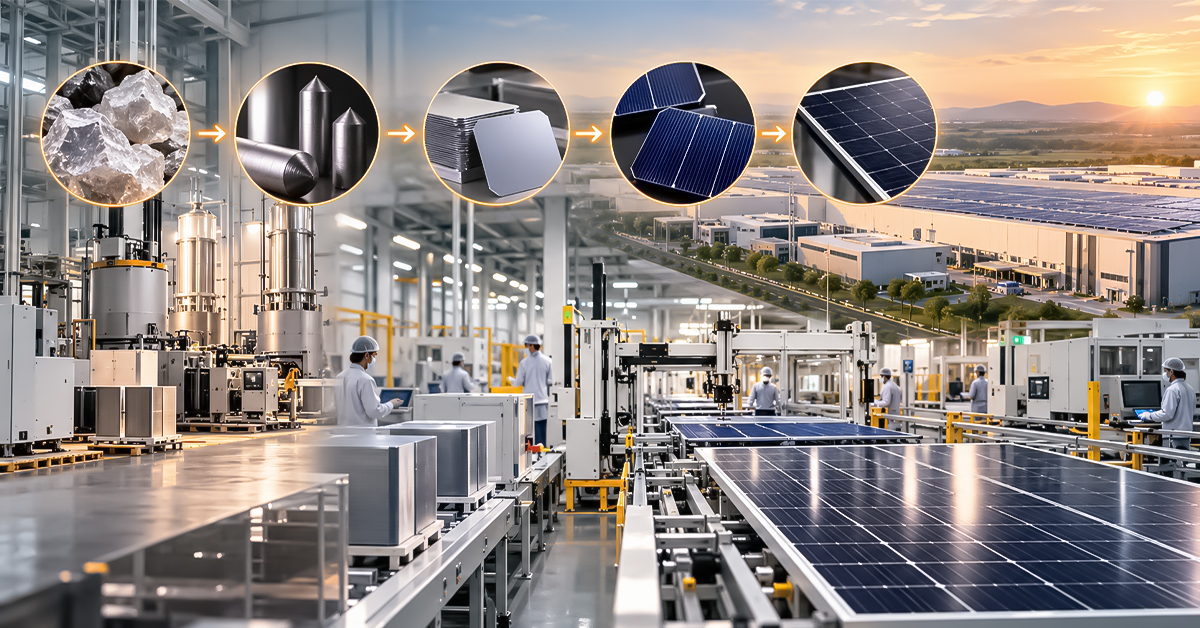
India’s Solar Manufacturing Needs a Balanced, Integrated Supply Chain
India’s solar manufacturing sector is undergoing a major transformation, with manufacturing capacity expanding swiftly across the value chain. However, a growing imbalance between module, cell and upstream manufacturing capacity is emerging as an important challenge for the industry.
According to a report by the Institute for Energy Economics and Financial Analysis (IEEFA) and JMK Research, India’s solar module manufacturing capacity reached 233 GW in June 2026. This is nearly seven times the country’s cell manufacturing capacity and around 116 times its ingot-wafer manufacturing capacity.
The imbalance across value-chain products, reflected in disparities between supply and demand, highlights the reality that expanding module manufacturing capacity alone does not necessarily translate into higher production.
Module Capacity Utilization Under Pressure
The report estimates that solar module manufacturing facilities in India are operating at an average capacity utilization of only 35–40%, significantly below the 50–65% utilization level considered necessary for sustainable operations.
One of the key factors behind this underutilization is the limited availability of domestically manufactured solar cells. While module manufacturing capacity has expanded significantly, cell production has not increased at the same pace.
For standalone module manufacturers, dependence on externally sourced cells can therefore create challenges in maintaining consistent production and keeping manufacturing lines fully utilized.
This situation demonstrates that capacity announcements and installed capacity figures tell only part of the story. The availability of upstream inputs is equally important in determining the actual output and efficiency of manufacturing facilities.
Moving Beyond Module Manufacturing
India’s solar manufacturing ambitions require a more balanced approach across the entire value chain—from polysilicon and ingots to wafers, cells and modules.
A stronger domestic upstream ecosystem can help reduce supply constraints, improve manufacturing continuity and create greater resilience within the solar industry.
This is particularly relevant as India seeks to strengthen domestic manufacturing and reduce dependence on imported components. Developing integrated manufacturing capabilities can enable greater coordination between different stages of production while supporting quality, traceability and technology development.
The Role of Integrated Manufacturing
The current market environment is creating a clear distinction between standalone module manufacturers and companies with integrated manufacturing capabilities.
Manufacturers that have access to their own cell production can have greater control over a critical input required for module manufacturing. Integration across the value chain can also support better coordination of production schedules, technology development and quality management.
For India, the development of integrated manufacturing ecosystems could therefore become increasingly important as the country expands its solar deployment and domestic manufacturing base.
Building a Stronger Solar Manufacturing Ecosystem
The current capacity imbalance provides an important lesson for India’s solar manufacturing strategy: capacity must grow in balance across the value chain.
The industry needs continued investment not only in module manufacturing, but also in upstream technologies such as ingots, wafers and high-efficiency solar cells.
An integrated approach can help create a more resilient manufacturing ecosystem, support domestic value addition and strengthen India’s position in the global solar supply chain.
At Indosol Solar, the focus on an integrated manufacturing ecosystem reflects this broader industry direction. The development of capabilities across ingot, wafer, cell and module manufacturing is aligned with the need for greater integration and stronger domestic supply-chain resilience.
As India’s solar industry enters its next phase of growth, the emphasis is increasingly shifting from simply adding manufacturing capacity to building efficient, integrated and technologically advanced production ecosystems.
The path ahead is not only about manufacturing more modules. It is about building the upstream capabilities required to manufacture them reliably, competitively and at scale.
India’s next chapter in solar manufacturing will depend on how effectively the entire value chain grows together.
About Indosol Solar
Indosol Solar Pvt. Ltd., the solar PV manufacturing arm of Shirdi Sai Electricals Limited, is driving India’s renewable energy ambitions through the development of a fully integrated, giga-scale solar PV manufacturing ecosystem. The company is building capabilities across the entire solar value chain right from quartz processing to high-efficiency solar photovoltaic modules.
Indosol Solar has commenced operations with a 500 MW solar module manufacturing facility at Ramayapatnam, Andhra Pradesh, which has been expanded to 1.3 GW facility. As part of its rapid growth strategy, the company is progressing toward its vision of establishing 10 GW of integrated solar PV manufacturing capacity by 2028, supporting India’s transition towards energy self-reliance and sustainable development.