
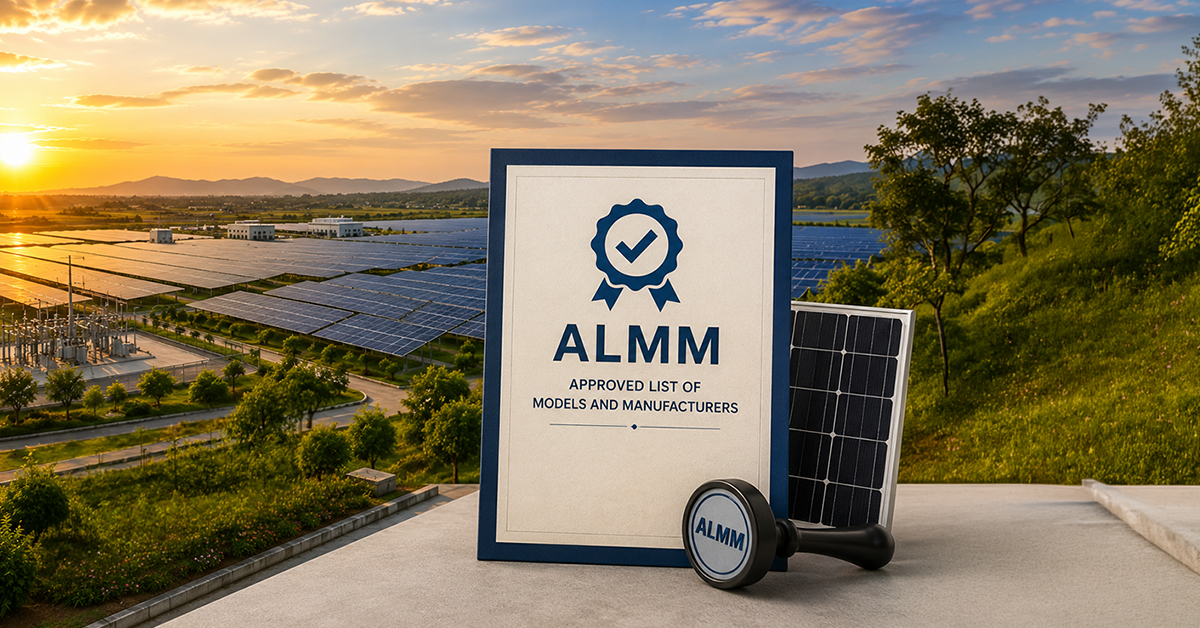
A Comprehensive Guide to ALMM Certification
The Ministry of New and Renewable Energy established the Approved List of Models and Manufacturers (ALMM) as a mandated compliance framework for solar PV manufacturers that supply modules and cells to solar projects associated with the government.
The structure guarantees:
- The dependability and quality of the product
- Traceability of domestic manufacturing
- Standards for long-term performance
- Using authorized producers in initiatives funded by the government
ALMM: What is it?
The acronym for Approved List of Models and Manufacturers is ALMM.
It is regulated by:
MNRE released the “Approved Models and Manufacturers of Solar Photovoltaic Modules (Requirement for Compulsory Registration) Order, 2019.”
Currently, the ALMM consists of:
List | Covers |
ALMM List-I | Solar PV Modules |
ALMM List-II | Solar PV Cells |
Proposed List-III | Wafers & Ingots |
By 2026, ALMM regulations will extend farther into the solar manufacturing supply chain, encompassing ingots, wafers, and cells.
The Significance of ALMM Certification India
- Without ALMM clearance, manufacturers might not be able to provide modules or cells for:
- Solar projects run by the government
- Rooftop systems connected to subsidies
- Projects involving net-metering
- Projects with open access
- Tenders from the government
Important Authorities for ALMM Certification India
- New and Renewable Energy Ministry: Releases authorized lists and controls ALMM policy.
- Indian Standards Bureau: Manages testing compliance and BIS certification.
- Labs Accredited by NABL: Solar cells and modules must be tested at accredited laboratories.
The guidelines set for ALMM Certification India navigate companies to move on energy transition path.
Qualifications for ALMM Enrolment:
Solar producers need to:
- Run or own manufacturing facilities
- Maintain a current BIS certification
- Comply with MNRE production traceability requirements
- Provide technical specifications.
- Pass the factory’s verification and inspection
- Manufacturers from both India and beyond may apply, subject to the relevant regulations.
ALMM List-I vs List-II
Feature | List-I | List-II |
Covers | Solar Modules | Solar Cells |
Status | Operational | Implemented progressively |
Mandatory Use | Government-linked projects | Increasingly mandatory |
Focus | Module manufacturing | Cell manufacturing |
Recent revisions expanded domestic solar cell capacity under ALMM List-II significantly in 2026.
ALMM for Imported Solar Modules
Imported modules generally face stricter scrutiny under domestic manufacturing policies.
India increasingly promotes:
- Domestic cell manufacturing
- Domestic module manufacturing
- Upstream localization
The government is also expanding ALMM toward wafers and ingots.
About Indosol Solar
Indosol Solar Pvt. Ltd. is the solar PV Manufacturing arm of Shirdi Sai Electricals Limited (SSEL). It is spearheading India’s Renewable Energy mission by developing fully vertically integrated giga-scale solar PV manufacturing ecosystem, spanning the entire value chain from quartz to high efficiency solar photovoltaics modules. It has commenced operations with a 500MW module manufacturing facility at Ramayapatnam in Andhra Pradesh. It is rapidly scaling up and aims to achieve 10GW of integrated solar PV manufacturing capacity by 2027.